
The Gujarat Teacher Eligibility Test (TET-2) is a crucial examination conducted by the State Examination Board (SEB), Gandhinagar, for aspiring teachers who wish to teach in upper primary classes (Standards 6 to 8) in government and aided schools across Gujarat. Clearing TET-2 qualifies candidates for recruitment as teachers/Vidhyasahayak in upper primary sections.
As of early 2026, the syllabus remains aligned with previous patterns (based on NCERT/Gujarat State Board curriculum), focusing on child pedagogy, languages, and subject-specific knowledge. The exam is objective (MCQs), carries 150 marks, lasts 150 minutes (2.00 hours), and has no negative marking.
Gujarat TET-2 Exam Pattern (Classes 6-8)
Total Questions: 150
Total Marks: 150
Duration: 2 hours
Question Type: Multiple Choice Questions (MCQs)
| Subject | No. of Questions | Marks |
|---|---|---|
| Child Development & Pedagogy | 30 | 30 |
| Language I (Gujarati / Hindi / Other) | 30 | 30 |
| Language II (English) | 30 | 30 |
| Mathematics & Science OR Social Studies/Science | 60 | 60 |
| Total | 150 | 150 |
Note: Candidates choose between (Mathematics & Science) or (Social Studies), depending on their preferred teaching subject.
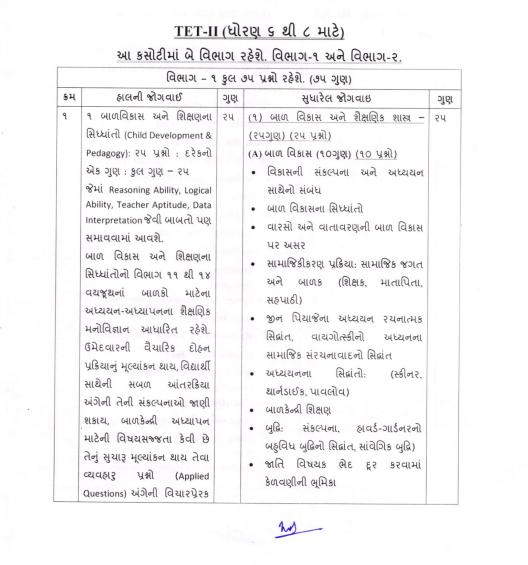
Detailed Syllabus for Gujarat TET-2 (Upper Primary – Std. 6 to 8)
1. Child Development & Pedagogy (30 Marks)
This section tests understanding of child psychology and teaching methods for upper primary students (age 11–14 years).
Key Topics:
- Concept of development and its relationship with learning
- Principles of child development
- Influence of heredity & environment
- Socialisation processes and the social world of children
- Theories of learning (Piaget, Kohlberg, Vygotsky) and their classroom implications
- Child-centred & progressive education concepts
- Critical perspective on intelligence & multi-dimensional intelligence
- Addressing learners from diverse backgrounds (including disadvantaged & deprived)
- Learning difficulties: addressing the needs of special children
- How children think & learn: cognitive processes
- Assessment & evaluation for learning
- Creating inclusive classroom environments
2. Language I (Gujarati / Hindi / Sanskrit / Urdu etc.) – 30 Marks
(Usually, Gujarati is the primary language)
Key Topics:
- Principles of language teaching
- Learning and acquisition of language
- Role of listening, speaking
- The functions of language, and how children use it as a tool
- Critical perspective on grammar
- Language skills (listening, speaking, reading, writing)
- Teaching-learning materials (textbooks, multimedia, multilingual resources)
- Remedial teaching
- Evaluating language comprehension & proficiency
- Challenges of teaching language in a diverse classroom
Teacher Eligibility Test TET-1 and TET-2 – Merit Calculatar
3. Language II (English) – 30 Marks
Focuses on comprehension, grammar, and English language teaching.
Key Topics:
- Comprehension of unseen prose passages
- Grammar & verbal ability
- Language acquisition & learning processes
- Role of listening & speaking; functions of language
- Principles of language teaching
- Teaching-learning materials (including multi-media)
- Evaluating language comprehension & proficiency
- Remedial teaching
- Challenges in multilingual classrooms
Read this: Online application for M.K. Bhavnagar University Degree Certificate
| TET- 2 (Std. 06 to 08) | Detailed Syllabus |
| Teacher Eligibility Test TET-2 (6 to 8) | Exam Syllabus PDF |
| Official website | SEBExam |
4. Mathematics & Science (OR) Social Studies – 60 Marks
Option A: Mathematics & Science (For Maths-Science teachers)
Read this: The National Education Policy (NEP) 2020.
Mathematics (approx. 30 marks):
- Number system & operations
- Algebra (expressions, equations, identities)
- Geometry (shapes, angles, symmetry, constructions)
- Mensuration (area, volume, surface area)
- Data handling & statistics
- Pedagogical issues (nature of mathematics, evaluation, error analysis)
Science (approx. 30 marks):
- Food (sources, components, cleaning)
- Materials of daily use
- World of living things
- Moving things, people & ideas
- Electric current & circuits
- Magnets & magnetism
- Natural phenomena (light, sound, force)
- Natural resources
- Pedagogical issues (nature of science, teaching methods, activities & experiments)
Read this Post: Gujarat Head Teacher Aptitude Test (HTAT) Exam Syllabus 2026.
Option B: Social Studies/Social Science (For Social Studies teachers)Key Topics:
- History – India & Gujarat (ancient, medieval, modern)
- Geography – physical, human, economic (India & world)
- Civics & Political Science – Constitution, governance, rights & duties
- Economics – basic concepts, Gujarat economy
- Pedagogical issues (evaluation, teaching-learning resources, project work)
Conclusion
Download the official syllabus PDF from sebexam.org (check latest updates). Study NCERT books (Class 6–8) for Mathematics, Science, and Social Studies. Practice previous years’ papers and mock tests. Focus heavily on pedagogy sections — they are scoring and common. For languages, improve comprehension, grammar, and teaching methodologies. Regular revision and time management during the exam are key.

3 Comments on “Teacher Eligibility Test TET-2 (Std. 6 to 8) Exam Syllabus.”
Comments are closed.